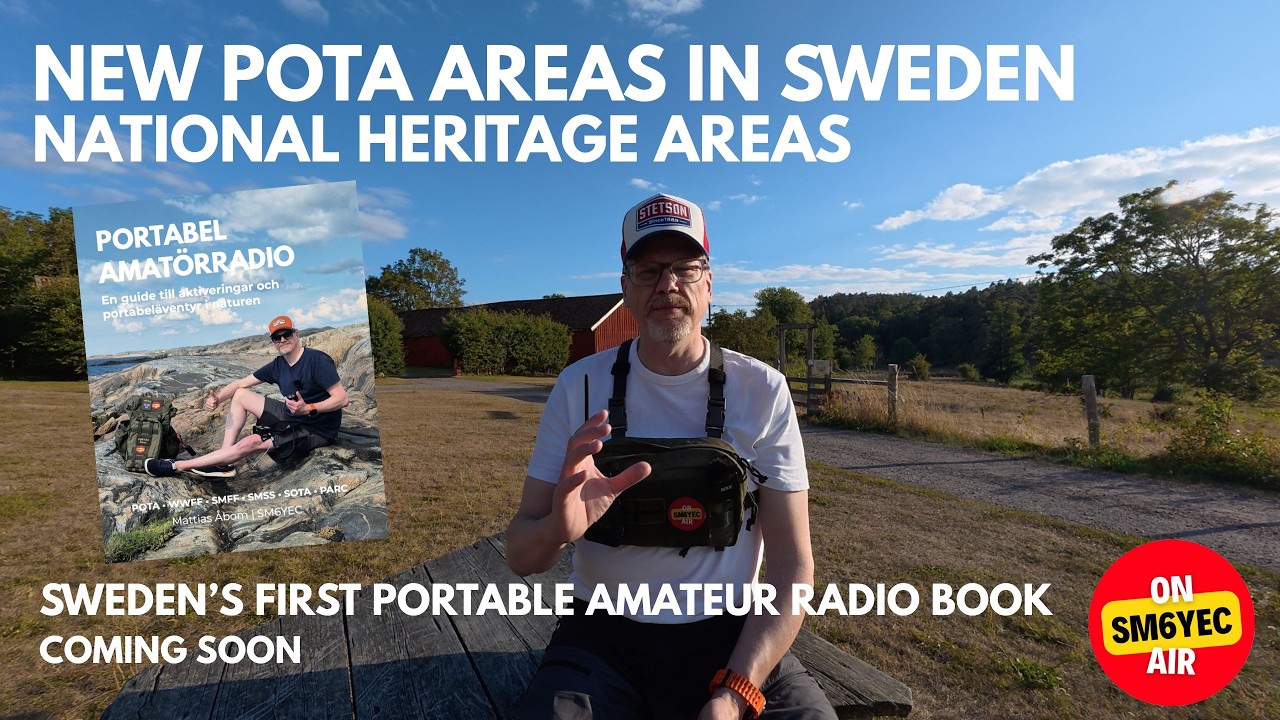
A new POTA area type in Sweden – National Heritage Areas!
In this video I talk about what National Heritage Areas mean within POTA, why they are interesting for portable amateur radio, and how they create even more opportunities to combine radio with nature, cultural environments and places you might otherwise never have visited.
I also talk about my upcoming book on portable amateur radio – Sweden’s first book focused on portable amateur radio.
I wrote the book to make it easier to get started with the different portable radio programmes. Information is often spread across several websites, and it can sometimes be difficult to find the right information, understand the rules and see the differences between programmes such as POTA, WWFF, SMFF and Swedish Lakes.
The book therefore brings much of that information together in one place. I explain how the different programmes work, how to plan an activation, what you need to think about, and how you can sometimes activate several different references during the same outing.
The main theme of this video, however, is why portable amateur radio is such a good way to develop as a radio amateur.
When you leave your fixed station at home, you suddenly have to think more carefully about things that can otherwise become routine. Which antenna is best for the location? How high can you get it? Should you use a dipole, inverted V, EFHW or vertical? How do direction and polarisation affect the result? Which band is likely to work best at that particular time and for the distance you want to cover?
On VHF, the choice of operating location becomes even more important. Height, clear horizon, terrain, forest, hills and buildings can all have a major effect on how far you can reach. Sometimes a better location can make a bigger difference than simply increasing transmit power.
Portable operation also teaches you a great deal about propagation. You experience in practice how the bands change during the day and how different frequency bands work for different distances and conditions.
And almost every portable outing involves some kind of problem solving. The antenna cannot be installed as planned, the location does not work as expected, the wind causes problems, or a band performs worse than you thought. Then you have to adapt the station and find another solution.
That is why I think portable amateur radio is one of the best ways to develop as a radio amateur. You do not just learn how to make contacts – you gradually build a better understanding of how the station, antenna, location and propagation all work together.
73 de SM6YEC